
Start a project

Web design / Consultants & Professional Services

Web design for consultants and professional services firms

When clients are buying expertise, the website must make a complicated offer feel clear, credible and worth discussing with your team.

Based in London. Working across the UK.

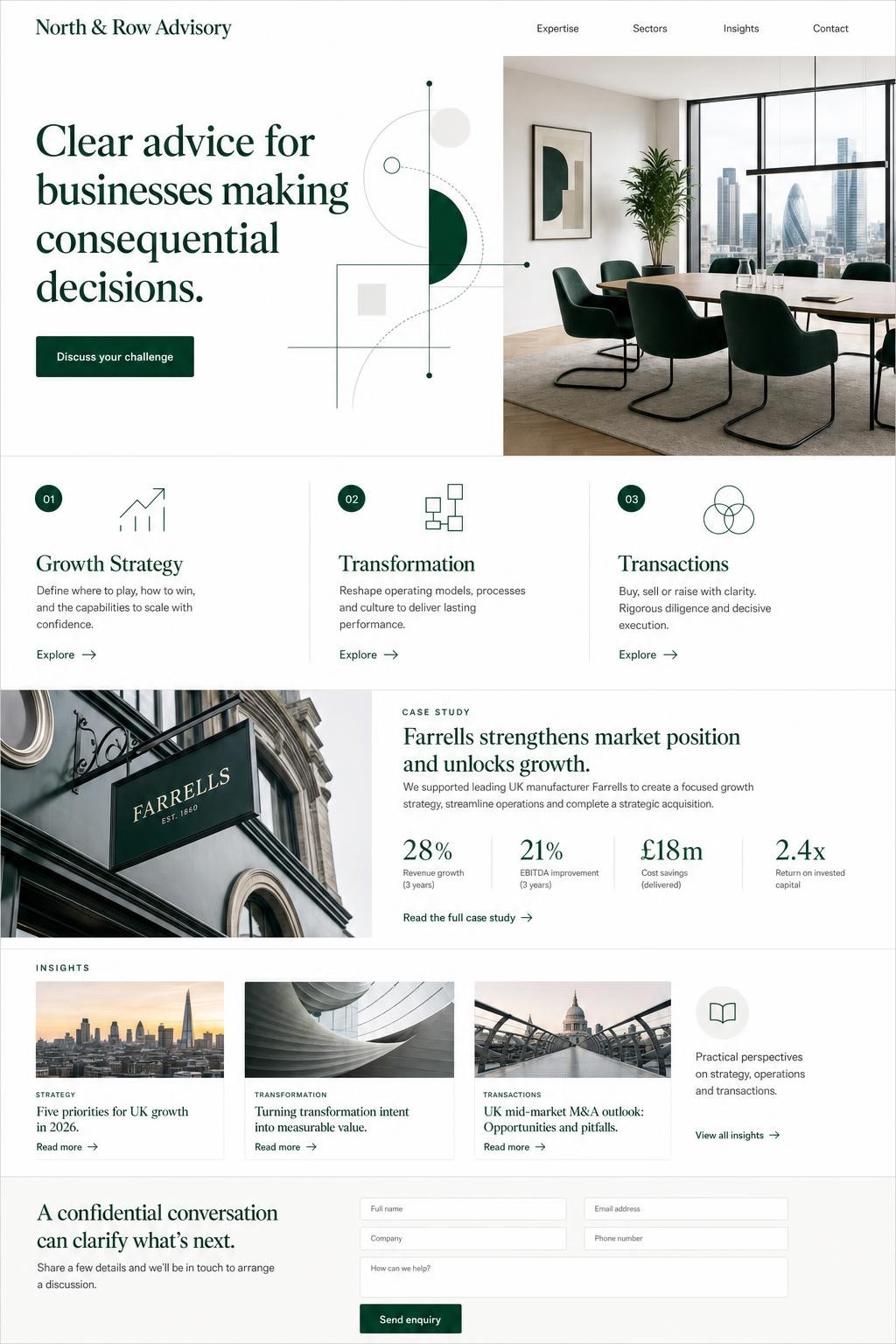
Concept website design for a professional services firm: authoritative white and British Racing Green editorial layout

ConceptNorth & Row Advisory · EC2 · a sample professional services firm website in the style we build

Customer journey

What your customers do before they call

A professional services website needs to explain more than a list of capabilities. Buyers need to know who you help, what you deliver and which person or team they should speak to. We turn that information into service pages, team profiles and clear routes to contact.

For a consultancy, that might mean explaining an assessment, its deliverables and the next discussion. For another advisory firm, the structure and approval process may differ. Your team confirms professional statements, credentials and any regulatory wording; website development does not establish compliance.

Questions your customers may search for

  • business consultants UK
  • management consultancy London
  • professional services firm near me
  • digital transformation consultants UK
  • specialist business adviser
  • operations consultancy for small businesses

Illustrative searches, not measured demand. We group related questions into useful pages and check priorities against your services, customer enquiries and available search data.

What we build

What we can plan for your professional services firm website

We agree the pages, content and enquiry journey in your proposal. The options below are shaped around your business; applications, connections and ongoing support require an agreed scope.

Service pages with a clear scope

We organise each distinct service around its audience, the problem it addresses, what the engagement includes and the next step. Related services link together without duplicating the same page under different names.

People and evidence in context

We design team profiles around approved biographies and verified credentials. Publishable client work is used only with permission; where it cannot be shared, a clearly labelled method example can explain your approach.

A consistent professional identity

Typography, photography and page layouts support your firm’s positioning while keeping detailed information readable. We review designs with your nominated decision-makers before building them.

Insights connected to services

Useful articles sit beside the expertise they explain, with author information and a relevant next step. We agree editing roles and content ownership so your team knows how updates are reviewed.

Enquiry and consultation journeys

We design short forms and clear contact routes that work on phones. Scheduling or CRM connections are checked for compatibility and scoped separately; we explain where an enquiry goes and what response the visitor can expect.

A considered website redesign

For an existing site, we review the page inventory and plan redirects where URLs change. The agreed build covers mobile layouts, search metadata and form checks, with access and handover responsibilities documented.

Connected systems

Optional tools beyond the public website

If your firm needs more than an enquiry form, we can scope a custom application alongside the website. Access permissions, data handling, existing systems and support requirements need a separate brief before we recommend a solution.

  • A client portal with agreed access and document permissions
  • An assessment questionnaire to prepare a consultation
  • CRM or scheduling connections where the provider supports them

AI solutions

Optional assistance with content updates

An AI-assisted drafting workflow can be scoped separately for approved material. Your team reviews factual claims, confidentiality and professional wording before publication; automated drafting is not a substitute for that review.

Available capabilities depend on your agreed plan, connected systems and publishing permissions. Usage, monitoring and human support are scoped separately.

AI assistants and workflow automation
  • Prepare drafts from approved, non-confidential notes
  • Suggest updates to service pages and team biographies
  • Keep a named reviewer responsible for publishing

Prepare a brief your partners can agree on.

Start with priority expertise, an approved source of evidence and a named content owner. A client portal is a separate application brief, not an assumed part of the website.

Website deliverables and approval roles

Agree the service-page structure, profile fields, publishing workflow and enquiry route. Identify who signs off professional wording and who keeps credentials current.

  • One approved service brief showing audience, scope and next step.
  • Permission for every client name, quotation and project example.
  • An enquiry destination and a responsible team member.

When does a client portal make sense?

Use a public website to explain services and begin a conversation. Scope a portal only when there is a repeated task, such as reviewing agreed documents or tracking an engagement. Define permissions, retention responsibilities and the systems involved before selecting technology.

Cost, timing and handover

Page types, copy preparation, partner reviews, migration and supported connections shape the quote. Agree milestones after these dependencies are known. Document access, editing instructions, supplier costs and support responsibilities before launch.

Discuss your firm’s website

Four stops from first call to live site.

  1. Discover

    Agree the audience, customer tasks, existing systems and evidence available. Confirm the scope, costs, responsibilities and dependencies before setting milestones.

  2. Design

    Review the page structure, mobile journeys and approved content. Resolve questions about imagery, editing and the next action before the build.

  3. Build

    Develop the agreed pages and connections. Check forms, permissions, responsive layouts and failure paths against the acceptance brief.

  4. Launch

    Complete the agreed checks and content approval, then confirm access, handover and the support route. Any ongoing work is defined separately.

Before we begin

Questions consultants and professional services leaders ask us

Answers specific to this business type. Anything else, just ask.

Can the site work for several different services or sectors?

Yes. We design a clear information structure that lets buyers enter by problem, expertise or sector without creating repetitive pages or an overwhelming menu.

What affects the cost and delivery time?

The number of page types, content preparation, migration work, integrations and review rounds all affect scope. We agree deliverables, dependencies, fees and payment stages in the proposal. Hosting, ongoing support and third-party costs are identified separately; a short project outline helps us prepare a useful quote.

How do you write about confidential client work?

Agree what your firm and client permit before drafting. Removing a name may still leave a client identifiable from the circumstances. Where disclosure is unsuitable, explain your method or use a labelled hypothetical example; do not turn it into a claimed result.

Can partners update their own profile and insights?

We agree editing roles and an approval process for biographies, credentials and articles. An optional AI assistant can prepare drafts from approved material; its publishing permissions, usage and support are scoped separately.

Can we keep our current CRM or consultation booking tool?

We first check its supported forms, links, embeds or API, along with account permissions and fees. Where a connection is practical, it is included in the agreed scope and checked before launch. Otherwise we recommend a clear contact route rather than promise an unsupported integration.

What should we prepare before a website redesign?

List your priority services, typical first-call questions, current URLs, approved team biographies and any publishable project evidence. Identify a content owner and the systems receiving enquiries. Existing Search Console and analytics access helps us assess which pages and journeys deserve attention first.

How do we judge whether the website is bringing useful enquiries?

Record the requested service, enquiry source where available and your team’s actual outcome: progressed, needs clarification or unsuitable. Compare equivalent periods alongside search clicks and form completions. A rise in page views alone does not establish more qualified opportunities.

Guides for consultants and professional services leaders

All consultants & professional services guides

Tell us about your professional services firm.

Tell us what you have in mind. We’ll email you to arrange a short discovery call.

Prefer email? info@brandflame.co.uk

Add business details (optional)

How we use your details: our privacy notice.

What happens next

  1. We read your message and review your current digital presence and goals.
  2. We book a thirty-minute video call at a time that suits your week.
  3. Once the scope is agreed, we’ll set out the proposed work, costs and schedule in writing.

We’ll review your enquiry and get in touch to discuss the next steps.

How we price your project