
Start a project

Web design / Restaurants & Hospitality

Web design for restaurants and hospitality businesses

Guests should feel the atmosphere, understand the offer and secure a table or stay before another tab wins their attention.

Based in London. Working across the UK.

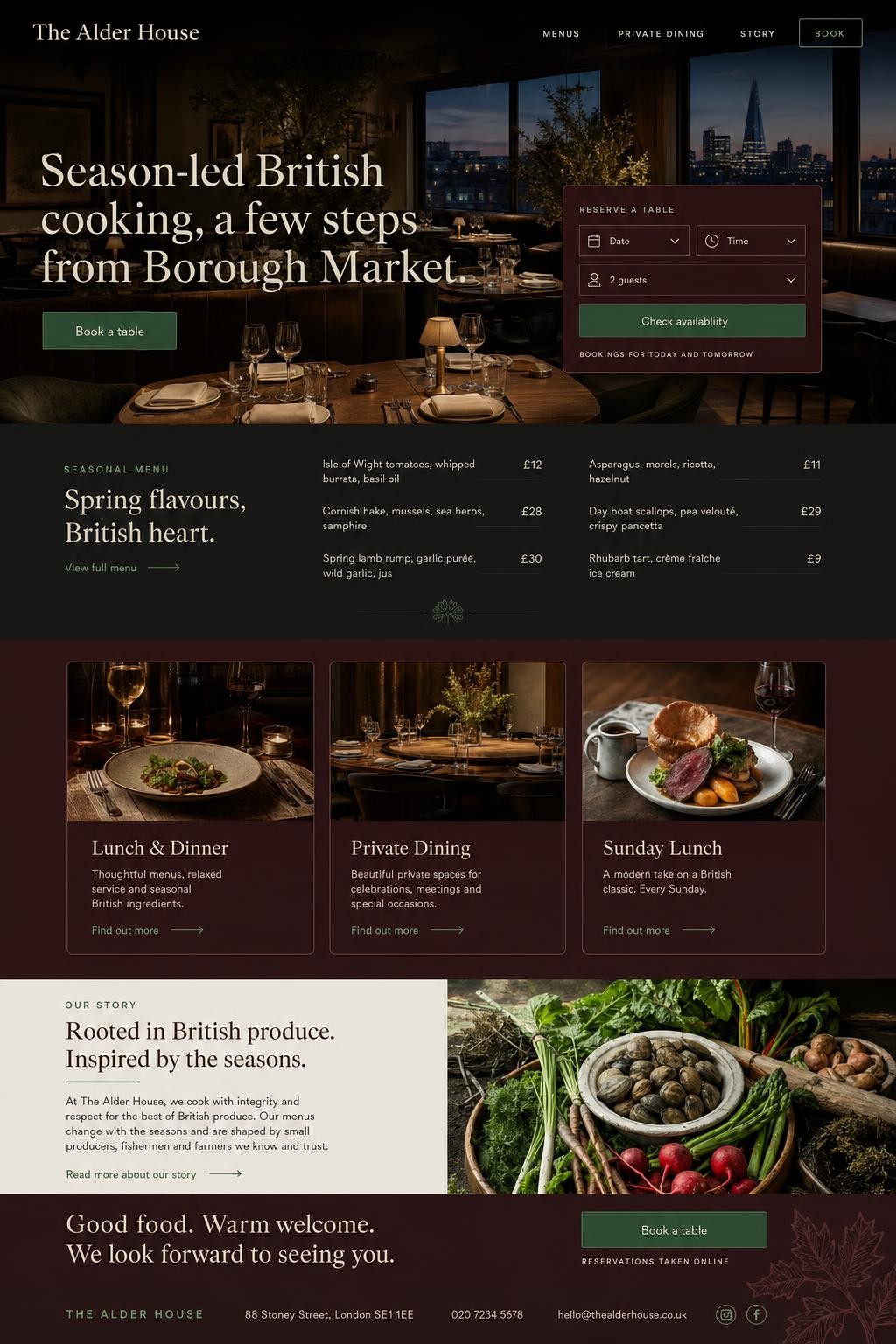
Concept website design for a restaurant: atmospheric oxblood and cream layout with menu and booking

ConceptThe Alder House · SE1 · a sample restaurant or hospitality business website in the style we build

Customer journey

What your customers do before they call

A guest choosing where to eat needs practical answers as well as a sense of the place. We design mobile-first menus, venue information and clear actions so they can decide whether your restaurant suits the occasion and see how to book.

A private dining enquiry needs a different route: space, capacity, example packages and a way to ask about dates. We give each journey the information it needs, without letting large images or decorative effects get in the way of essential details.

Questions your customers may search for

  • restaurant near me
  • private dining London
  • restaurant online booking
  • best Sunday lunch London
  • event venue hire near me
  • boutique hotel direct booking

Illustrative searches, not measured demand. We group related questions into useful pages and check priorities against your services, customer enquiries and available search data.

What we build

What we can plan for your restaurant or hospitality business website

We agree the pages, content and enquiry journey in your proposal. The options below are shaped around your business; applications, connections and ongoing support require an agreed scope.

Readable menus on a phone

We build menus as web content, with clear sections, dishes and prices. Your team supplies and checks dietary information. A printable PDF can remain as a secondary download rather than the only way to read the menu.

A clear reservation route

Booking actions sit beside menus and venue details. We check whether your provider supports a link, embed or integration, then agree the approach. Availability and confirmation remain with the reservation system unless a different workflow is explicitly scoped.

Atmosphere without losing the essentials

We use approved food and venue photography within a responsive design, with appropriately sized images. Opening times, location and contact actions stay readable alongside the visual story.

Private dining and event enquiries

Where needed, we create pages for spaces, capacities and packages, plus a form for dates, group size and contact details. Visitors see that their request needs a reply rather than treating it as a confirmed booking.

Useful venue information

Location pages can bring together address, opening hours, directions and the access information you provide. We include appropriate search metadata and factual structured data, without promising search rankings.

Updates your team can manage

We agree who edits seasonal menus, opening times and notices, then include the relevant editing access and handover in the scope. Gift cards or paid experiences are optional commerce work, not assumed parts of every website.

Connected systems

Work with the systems behind your venue

We assess your reservation provider before promising a connection. Supported features, account access, subscription costs and the experience on a phone determine whether a link, embed or custom integration makes sense. Gift cards and payments require a separate commerce scope.

  • Reservation hand-offs checked against your provider’s supported options
  • Event enquiries routed to an agreed team or system
  • Optional gift-card or payment connections with fees and responsibilities explained

AI solutions

Optional help with seasonal updates

An AI-assisted workflow can prepare drafts from the information your team provides. Staff remain responsible for checking prices, dietary details, opening times and availability before anything is published. This is an optional addition to the website project.

Available capabilities depend on your agreed plan, connected systems and publishing permissions. Usage, monitoring and human support are scoped separately.

AI assistants and workflow automation
  • Draft seasonal notices from approved information
  • Prepare event-page updates for staff review
  • Keep menu and venue details under human approval

Plan the website around a real visit.

A first-time guest needs a readable menu, accurate venue details and a clear next action. Give staff a workable way to keep those essentials current.

Prepare the venue information

Agree menus, venues, languages and the journeys for ordinary visits, private dining and events. Staff supply and approve factual information.

  • Menu sections, current prices and your approved dietary details.
  • Opening hours, directions and practical access information.
  • Permitted food and venue photography, with a content owner.

Test the reservation hand-off

Check the existing provider on a phone. A supported link may be sufficient; an embed or custom integration adds provider permissions, fees and testing. Test unavailable slots, failed requests and the source of the booking confirmation. An event enquiry must not appear to be a confirmed reservation.

Agree ownership after launch

The proposal separates website work from reservation subscriptions, payment fees and optional support. Agree who updates menus and special opening times, how changes are reviewed, and what staff receive at handover. Content readiness and provider access affect the schedule.

Discuss your hospitality website

Four stops from first call to live site.

  1. Discover

    Agree the audience, customer tasks, existing systems and evidence available. Confirm the scope, costs, responsibilities and dependencies before setting milestones.

  2. Design

    Review the page structure, mobile journeys and approved content. Resolve questions about imagery, editing and the next action before the build.

  3. Build

    Develop the agreed pages and connections. Check forms, permissions, responsive layouts and failure paths against the acceptance brief.

  4. Launch

    Complete the agreed checks and content approval, then confirm access, handover and the support route. Any ongoing work is defined separately.

Before we begin

Questions restaurant, venue and hospitality teams ask us

Answers specific to this business type. Anything else, just ask.

Can you connect our existing booking platform?

We first check the links, embeds or API your provider supports and the permissions available on your account. We then agree a suitable route and check the hand-off on mobile. Provider subscriptions, transaction fees and custom integration work are identified separately; not every platform supports every option.

Should menus be PDFs?

A web menu lets guests read dishes and prices without zooming a document. We recommend it as the main version, with an optional printable PDF. Your team supplies and verifies the menu and dietary information, and we agree how both versions will be kept current.

Can our staff update menus and opening times?

Yes, editing access and a handover can be included in the agreed scope. We identify which staff need access and how changes should be checked. Ongoing updates managed by BrandFlame, or AI-assisted drafting, are separate support options.

What affects the quote and launch date?

The number of venues, page layouts, menu formats, content preparation and booking or payment connections affect the work involved. We confirm scope, fees, review rounds and dependencies before agreeing a schedule. Hosting, maintenance and third-party charges are explained separately.

Who supplies the photography and written content?

We agree this before starting. You can supply approved photographs, menus and venue details; any copywriting or photography requirements are scoped in the proposal. You confirm factual information and permission to use supplied material before launch.

Can one site cover several venues or private dining?

Yes. We can plan distinct venue pages with their own menus, hours and reservation routes, and separate private-event enquiry journeys. The page structure and form requirements are agreed around how your team operates.

Guides for restaurant, venue and hospitality teams

All restaurants & hospitality guides

Tell us about your restaurant or hospitality business.

Tell us what you have in mind. We’ll email you to arrange a short discovery call.

Prefer email? info@brandflame.co.uk

Add business details (optional)

How we use your details: our privacy notice.

What happens next

  1. We read your message and review your current digital presence and goals.
  2. We book a thirty-minute video call at a time that suits your week.
  3. Once the scope is agreed, we’ll set out the proposed work, costs and schedule in writing.

We’ll review your enquiry and get in touch to discuss the next steps.

How we price your project