
Qualifying landscaping enquiries before a site visit
Use this repeatable enquiry script to capture goals, location, timing, access and decision readiness, then route each lead to a clear next step.
BrandFlame Studio6 September 2026· 4 min read· AI-assisted
About this guide. BrandFlame’s editorial desk covers website design, enquiry journeys and connected business systems. Sources support factual guidance; worked examples are illustrative unless identified as a documented project.
Meet the team · Research and corrections policy · Try our workflow demo
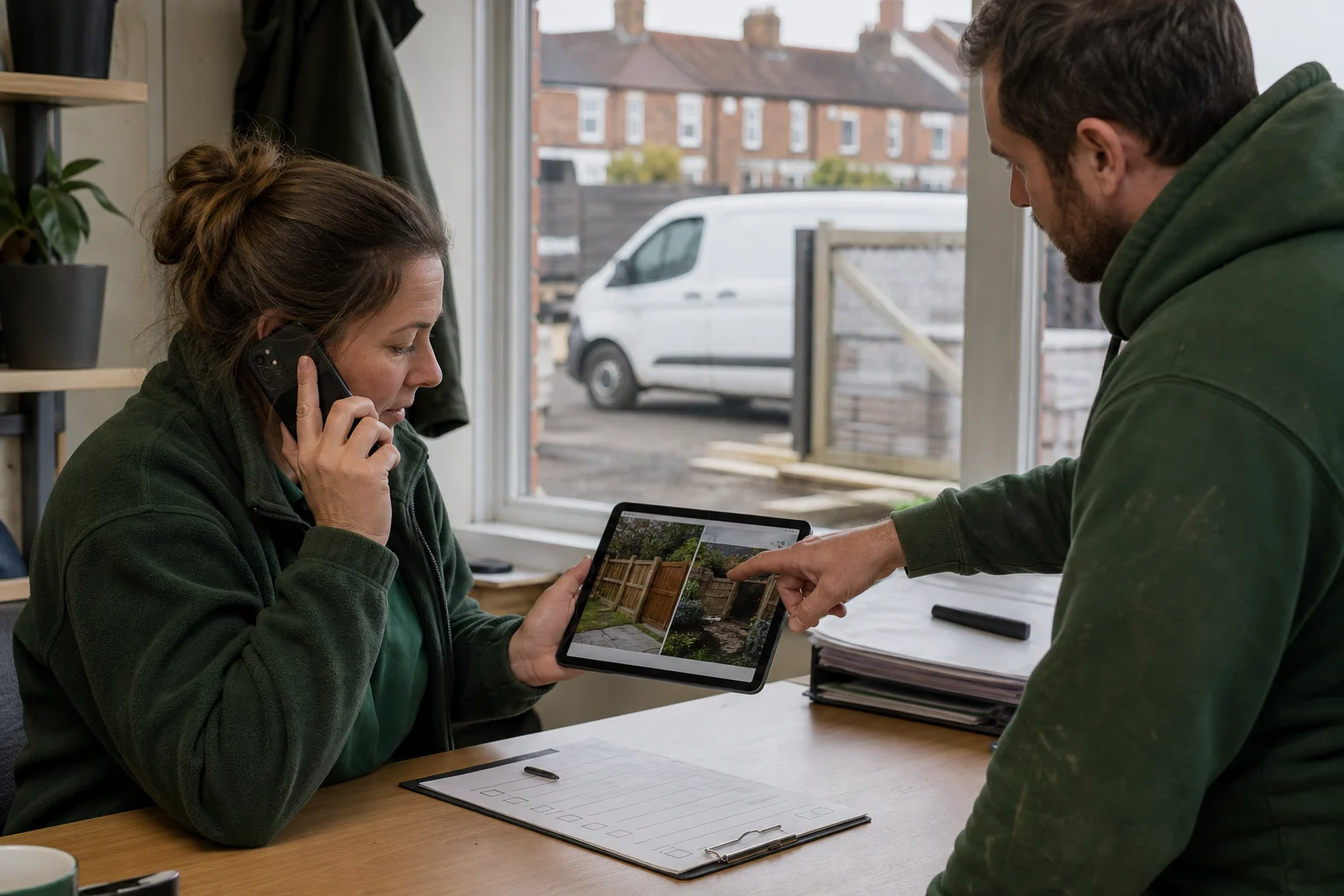
Most landscaping enquiries do not need an immediate site visit. They need a short, consistent conversation that establishes what the customer wants, whether the location and timing fit your operation, and whether the right people are ready to proceed.
The aim is not to design a garden or promise a price remotely. It is to decide the next sensible step: request a few details, book a paid or free consultation, arrange a maintenance survey, or decline politely.
Set the boundary: qualify first, assess on site
A useful first call produces a brief, not a specification. The British Association of Landscape Industries’ Accredited Designer Quality Standard treats the client brief, fee proposal and site survey as distinct evidence. Its brief guidance covers the aims of the design plus key site factors and constraints; the survey then captures measurements and observations.
That separation protects both sides. Your coordinator can record what the customer reports, but should avoid confirming drainage solutions, structural feasibility, exact quantities or a fixed build price before a competent person has inspected the site.
Use an opening such as: “I’ll ask six short questions so we can decide who should speak with you next. We’ll confirm measurements, conditions and technical recommendations at the appropriate site stage.”
Six landscaping enquiry questions to ask
Keep the questions conversational, with a standard field behind each answer.
- What would you like the space to do better? Ask for the outcome before the shopping list: easier maintenance, safer access, entertaining, play, planting, privacy or a complete redesign. Record the customer’s own words.
- What work are you considering? Let them select broad categories such as design, hard landscaping, planting or ongoing maintenance. Ask what must stay, but do not diagnose from photographs.
- Where is the property? Collect the postcode and whether it is domestic, commercial or communal. Check this against your service area and the type of work your team accepts.
- What access and constraints do you already know about? Ask about side or rear access, steps, gates, parking, shared routes, pets, children, public access and other trades. Request wide and close photographs only if they help triage. The HSE says pre-construction information should cover boundaries, adjacent land use, access and measures to exclude unauthorised people; these affect how work is planned (HSE: protecting the public). Treat the answers as prompts for later assessment, never as a remote risk assessment.
- When would you like the work completed, and is that date flexible? Separate a genuine event deadline from a preference. Ask when someone can provide access for a visit and whether planning, landlord or management-company decisions are outstanding.
- Who will decide, and what happens after the visit? Establish who owns or manages the property, who needs to approve the scope and whether they can attend. Ask whether the customer has set a working investment range. Explain that this helps match the enquiry to an appropriate service; it is not a quotation.
Where the proposed work may involve construction activity, make the eventual handover to the surveyor explicit. HSE guidance says information available at tendering should inform time and resource allowances, while site history, underground services, unusual ground, nearby routes and other activity may need consideration (HSE: planning construction work). General intake questions cannot settle those matters.
Route every answer to a defined next step
Avoid a vague “someone will call you”. Give coordinators a simple routing table:
| Intake result | Next action | Customer message |
|---|---|---|
| In area, suitable service, decision-makers engaged | Book the correct consultation type | Confirm duration, fee if any, attendees and required photos or documents |
| Promising but key facts missing | Send one structured information request | List the missing items and a response date |
| Timing or location does not fit | Offer a realistic later slot or decline | Be clear; do not leave an unusable lead open |
| Technical uncertainty or significant constraint | Escalate to a competent lead before booking | Explain that the team needs to review the reported constraint |
| Maintenance request | Route to maintenance survey or quote workflow | Capture frequency, approximate area and service expectations |
Hypothetical example: a homeowner wants a new patio before a June celebration, but reports no side access and says their partner must approve the spend. The coordinator records the desired outcome, deadline and access issue, requests photographs, and offers a joint consultation slot. They do not suggest machinery, promise the June date or estimate the patio from a phone image.
Build a lightweight workflow before custom software
Start with your existing form, shared inbox or CRM. Make the six fields required, add the five routing outcomes, and create two templates: “information needed” and “consultation confirmed”. Assign an owner and follow-up date whenever an enquiry remains open.
A practical flow is:
Web form or phone note → duplicate check → coordinator review → route → confirmation → site-visit record.
Connect the form to your CRM or job-management system if both already support the integration. A bespoke portal is worth considering only when the standard tools cannot handle important needs such as multiple sites, commercial approvals or complex document collection. BrandFlame’s landscaping digital transformation service can help map that process before any build is proposed.
AI can assist without becoming the estimator. For example, it can turn typed call notes into a draft summary, flag empty intake fields and prepare a follow-up message. Keep the original notes, require a person to check the output, and prevent the model from inventing measurements, technical advice, availability or prices.
Review the workflow after a month using operational questions, not invented benchmarks: Which fields are often missing? Which routes are frequently changed after review? Are unsuitable visits still being booked? Adjust the script, responsibilities and templates before adding more technology.
Sources
Written with AI assistance and published automatically after checks for structure, source references and links. No human review is required before publication. How we write these guides.
More for landscapers and garden designers
All landscaping guides
Landscaping10 September 2026· 4 min read
Give your landscaping crew a clear job handover
Put the current scope, plans and practical site information in one job brief. A guide to keeping your office and landscaping crew working from the same details.